Daphnia fish food can mean a live culture or a prepared product such as frozen daphnia. Choose the form before following feeding advice: a starter culture needs ongoing care, while a frozen pack needs the manufacturer’s storage and preparation instructions. Neither the name nor the fish’s enthusiasm proves that the food can replace a suitable routine diet.
This guide helps you decide between live and frozen daphnia, check size and portion, and separate practical feeding advice from claims about curing digestive problems.
What are daphnia?
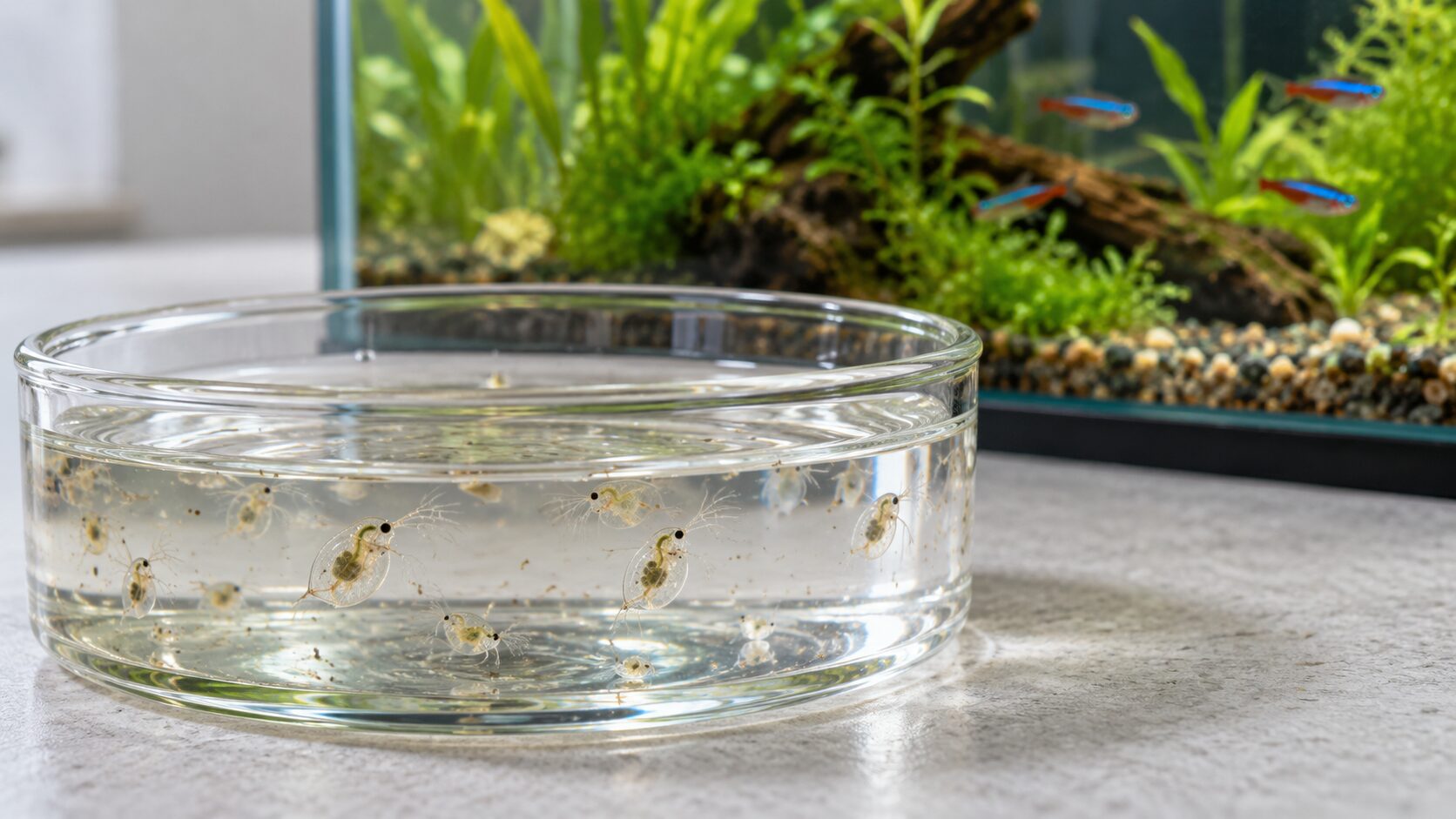
Daphnia are small freshwater crustaceans commonly called water fleas. Suppliers sell live starter cultures for aquarium feeding, and some manufacturers sell them as frozen food. Product form, organism size, and handling all matter. A package labeled daphnia is not a promise that every piece will be small enough for newly hatched fish.
For the broader benefits and sourcing risks of live foods, read our live aquarium fish food guide. Here, the narrower question is whether a live culture or prepared daphnia fits the aquarium you maintain.
Live culture versus frozen daphnia
| Choice | Useful when | Check before buying |
|---|---|---|
| Live starter culture | You want live feeding and can maintain a separate culture following the supplier’s instructions. | Exact culture type, size range, arrival care, ongoing maintenance, and current availability. |
| Frozen daphnia | You prefer a prepared food and can maintain the required frozen storage. | Package instructions, organism size, portioning, freezer requirements, and delivery conditions. |
The Shrimp Farm’s live-culture listing is an example of a product that requires culture care, not simply a jar of prepared flakes. Its guidance emphasizes gentle aeration, stable conditions, light feeding, and harvesting only part of a culture. These are supplier instructions, not a universal recipe for every daphnia species or culture setup.
The Ocean Nutrition Europe frozen product is a different example: its page identifies a frozen preparation and a stated organism size of 2-3 mm. That figure belongs to the product checked, not every daphnia culture. Use the size of your actual food and the fish’s ability to eat it, especially when feeding fry.
Which fish can eat daphnia?
Suppliers often describe daphnia for small freshwater fish, but a broad product description cannot replace species-specific guidance. Confirm that the food is suitable for your fish’s dietary needs and mouth size. Watch a first feeding rather than assuming that fish of similar body size feed identically.
In a community aquarium, some fish may reach food quickly while others do not. Check the whole tank, not just the first fish to feed. Very young fry may need a smaller food than adult daphnia provide. Do not treat all fry, nano fish, or herbivorous fish as one feeding group.
The Merck Veterinary Manual notes that nutrition knowledge for aquarium species is not equally complete and that feeding needs vary. That is a reason to avoid one universal protein target or feeding frequency for all fish.
Can daphnia replace the regular food?
Do not assume that one live or frozen ingredient supplies a complete diet. Check the manufacturer’s intended feeding use and reliable guidance for your species. Daphnia can be considered within a suitable feeding plan, but adding variety is not the same as establishing nutrient completeness.
A single printed nutrient percentage does not resolve that question. Frozen foods contain substantial water, while dry foods are expressed on a different moisture basis. The Ocean Nutrition example lists moisture along with its other analytical constituents. Comparing that product’s printed protein number directly with a dry pellet would not be a meaningful quality ranking. See our fish food nutrition and label-reading guide.
Do daphnia cure constipation or bloat?
This guide does not recommend daphnia as a treatment for either condition. Supplier pages sometimes discuss roughage or describe daphnia as helping digestion. Those statements do not establish a diagnosis or prove that feeding daphnia treats the cause of a swollen fish.
If a fish has a persistent health problem, do not keep increasing food in an attempt to fix it. Review water conditions and obtain appropriate fish-health advice. A food choice should not replace investigation of a problem or species-specific veterinary guidance.
A first-feeding checklist
- Confirm the food form, source, and intended use.
- Check organism size against the actual fish, rather than assuming all daphnia fit all fry.
- Follow the package or supplier’s preparation and handling directions.
- Offer a small portion and watch whether the fish actually eat it.
- Review leftovers and the total food offered that day before repeating the portion.
There is no fixed spoonful or cube count that applies to every aquarium. Our feeding-portion guide covers observation and adjustment. Live food is not permission to add unlimited quantities, and frozen food is not portioned correctly merely because it comes in cubes.
What changes if you maintain a live culture?
A culture is a separate maintenance task. Follow the supplier’s guidance for water, aeration, feed, and harvesting; do not assume that conditions suitable for your aquarium fish are automatically the best conditions for the culture. Keep culture equipment organized and avoid relying on an unknown outdoor collection source.
The Shrimp Farm’s care information recommends modest feeding and partial harvesting rather than removing the whole colony. It also discusses keeping more than one culture as a backup. These are useful planning considerations, not a promise that a culture will never fail. This article does not provide an untested culture recipe or guarantee continuous production.
What changes with a frozen pack?
Check storage, transport, and preparation before purchase. Keep the food under the specified conditions and follow the instructions for the exact pack. Instructions for another frozen food are not automatically appropriate for frozen daphnia, and there is no universal after-opening lifetime across all products.
For printed dates and handling, use our fish food storage guide. When instructions are unclear, ask the manufacturer instead of copying a generic thawing or refreezing rule from a forum.
Daphnia feeding questions
Are all daphnia small enough for fry?
No. Size varies with the actual product or culture. The 2-3 mm figure cited above is a specific manufacturer’s example. Confirm the size your fry can take.
Is live daphnia automatically better than frozen?
No universal ranking is supported here. Live cultures and frozen products involve different handling, feeding presentation, and maintenance. Choose according to the fish and the routine you can manage.
Can I stop watching leftovers because the food is live?
No. Observe feeding and water conditions. Live food is still part of the aquarium’s feeding load, and its presence does not make portion control unnecessary.
Does a supplier listing mean the product is available now?
No. Check stock and delivery conditions before ordering. A live-culture page can remain online while stock is unavailable. This guide does not claim current retail stock, price, or Amazon availability.
Sources and scope
- Ocean Nutrition Europe: frozen daphnia product and analytical information
- The Shrimp Farm: live daphnia starter culture and supplier care instructions
- Merck Veterinary Manual: fish nutrition
Product examples distinguish formats. This is not a hands-on comparison, a medical treatment guide, or a ranked shopping list.