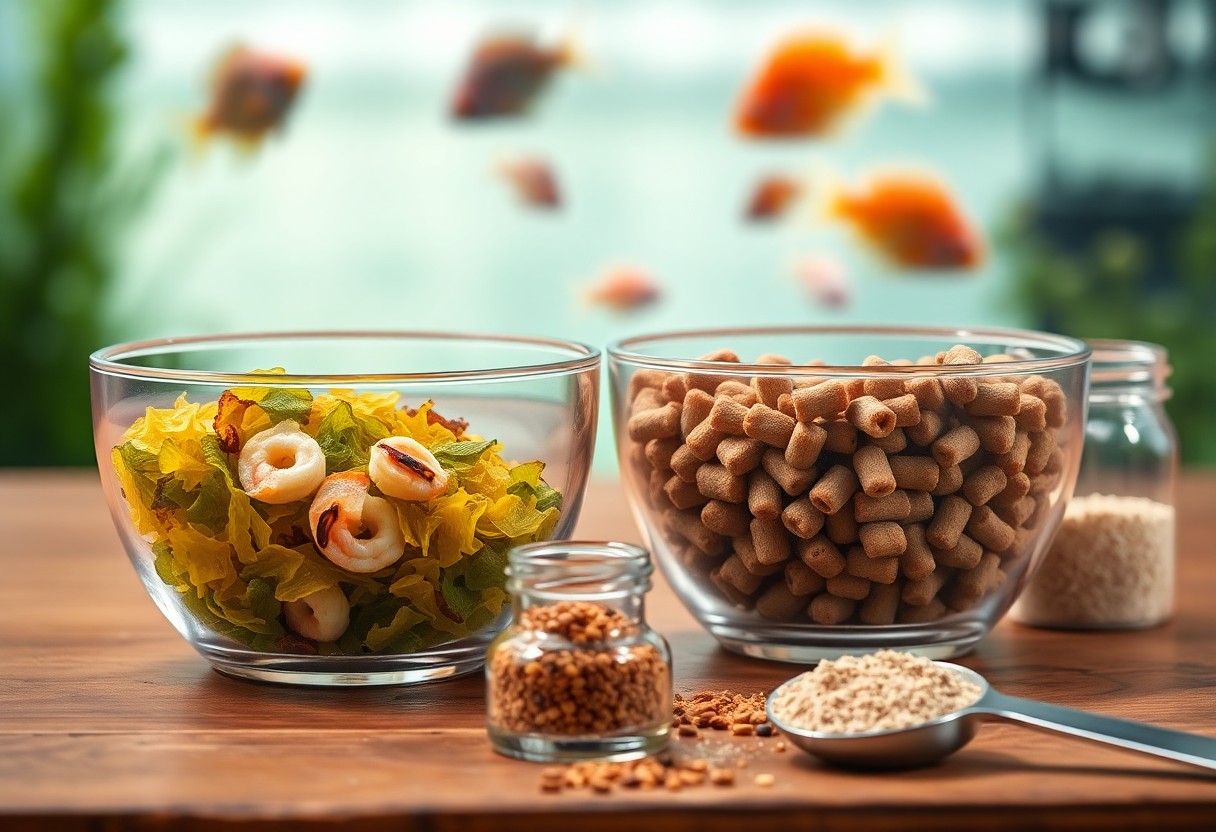
Fish food flakes are made from a product-specific mixture of ingredients formed into thin pieces. The exact recipe matters more than the word “flake”: read the ingredient list, intended fish, and feeding directions on the package. Pellets are not automatically more nutritious, suitable only for large fish, or always sinking. This guide compares the two formats without treating their shape as a quality ranking.
What goes into a fish food flake?
A real label is more useful than a universal recipe. The 3.5-ounce package image on Aqueon’s Tropical Flakes page, inspected for this guide, lists whole wheat flour, fish meal, soy flour, shrimp meal, and other ingredients. It also identifies added vitamins and minerals. This is one package example, not the recipe for every flake food, and formulas or packaging can change.
An ingredient’s presence is not, by itself, proof that a food is harmful, complete, or appropriate for your fish. Do not label all grain ingredients as useless fillers or assume that an expensive package guarantees a suitable diet. Our fish food ingredient guide explains the separate job of reading ingredient names.
Flakes versus pellets: compare the actual products
| Question | What to check |
|---|---|
| Where does the food travel? | Check whether the exact food floats or sinks, then watch whether the intended fish reach it. |
| Can the fish take the pieces? | Compare piece size and texture with the fish’s mouth and observed feeding behavior, not just its body size. |
| Does the formula suit the fish? | Read the intended species or feeding group and the manufacturer’s directions. Shape does not establish suitability. |
| How much is left uneaten? | Observe the portion actually consumed. Do not assume one format prevents overfeeding. |
| How should it be stored? | Follow the product’s printed date and storage instructions rather than assigning all flakes a shorter usable life. |
Not all pellets sink, and not all pellets are large
Aqueon describes its Tropical Flakes as floating flakes for surface feeding. That is useful information about that product, not a rule that every fish near the surface must eat flakes.
For a clear counterexample to the claim that pellets always sink, Hikari describes Betta Bio-Gold as a floating pellet. Its Micro Pellets page identifies tetras, barbs, and other small-mouthed tropical fish as the intended users. These are examples of different product designs, not recommendations to give either food to every aquarium fish.
Hikari’s pellet manufacturing overview also distinguishes round, disk, hard, sponge-like, and granular types. A label saying “pellet” therefore does not tell you everything about the piece’s size, texture, or use. Read the exact product description and observe feeding access in your own aquarium.
Does one format have better nutrition?
Do not choose a winner from shape alone. Compare the labels and intended diets of the exact foods under consideration. A pellet for one species and a flake for a different species are not a controlled test of which format is better.
The ingredient list and guaranteed analysis answer different questions. Our fish food nutrition and label guide explains how to read that information. This format comparison does not establish a universal protein target, prove digestibility, or promise better growth, color, or disease resistance.
Water clarity depends on more than food shape
Aqueon says its flakes will not cloud water when fed as directed. Hikari warns on its Micro Pellets page that overfeeding can cause water-quality issues. Together, these product-specific directions are a reason to avoid the blanket claim that flakes pollute water while pellets do not. They are manufacturer statements, not an independent head-to-head water-quality trial.
Start with the directions for the exact food, observe whether all intended fish can eat, and check for uneaten food. Do not keep adding food merely because it disappears from the surface: it may have moved lower in the aquarium rather than been eaten. If feeding or water quality changes unexpectedly, investigate the aquarium rather than assuming a switch of food shape solves the problem.
Storage and freshness
Keep the product identified and follow its own storage instructions and printed date. Neither “flake” nor “pellet” establishes a universal shelf life after opening. Our fish-food storage and spoilage guide covers moisture, packaging, and questionable changes in a container.
Frequently asked questions
Are flakes suitable for every fish?
No single format or formula should be assumed suitable for every species. Check the intended fish, piece size, feeding access, and directions for the product. Avoid using a generic list of species as a substitute for those checks.
Are pellets always higher in protein?
No format-wide comparison has been established here. Read the two actual labels instead of assuming that a denser-looking piece contains more of a particular nutrient.
Why might a fish ignore a new food?
This guide cannot diagnose an appetite change. Check whether the food is intended for that fish and physically accessible, and review the manufacturer’s transition directions. Do not assume refusal proves the food is spoiled or that simply changing brands will fix it.
Can a homemade flake recipe replace a formulated diet?
A homemade mixture should not be assumed nutritionally complete merely because it dries into flakes. This guide does not provide a recipe, species-specific nutrient formulation, or testing evidence to support replacing a formulated diet.