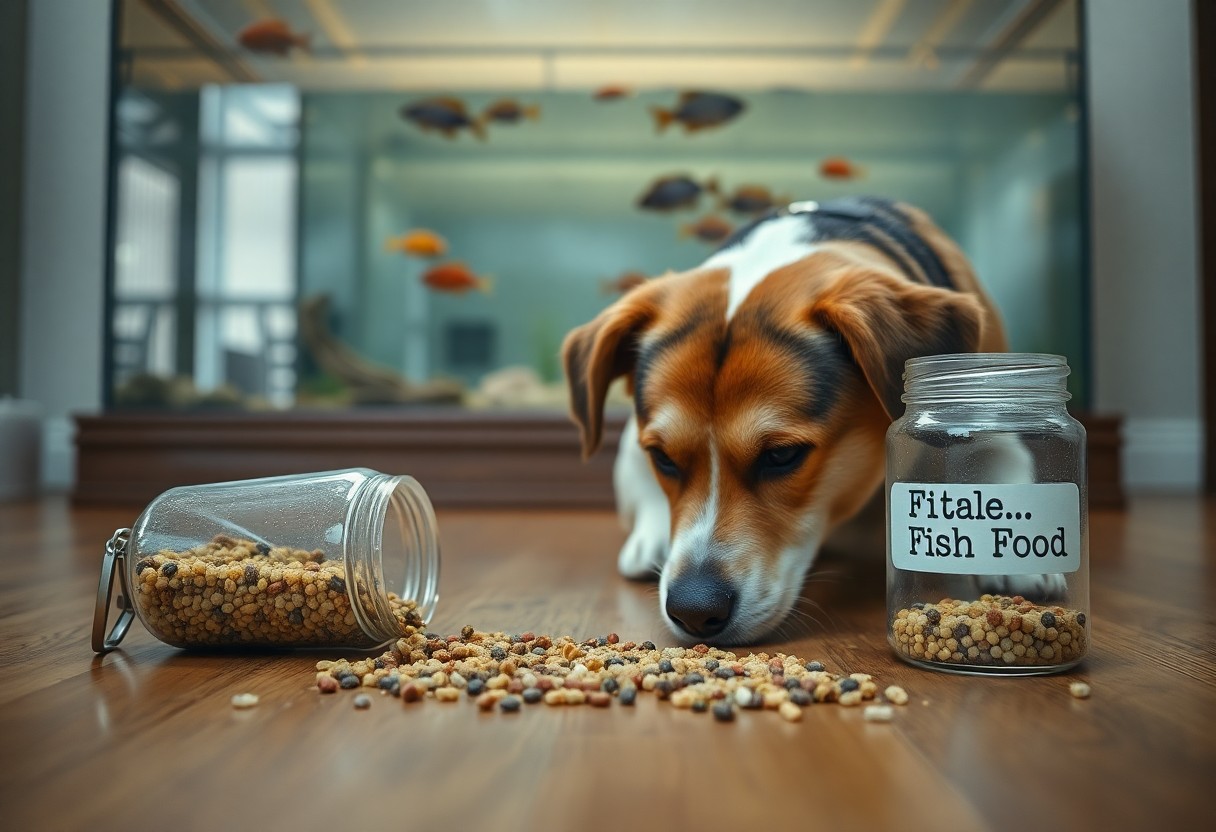
Fish food cannot be classified as safe or toxic for a dog from the category name alone. A label, a quantity, and the animal’s circumstances are needed for a case-specific assessment. This page explains how to identify the product and avoid misleading ingredient claims; it does not calculate a toxic dose or diagnose an exposure.
If this is happening now, use the accidental-ingestion checklist and contact a veterinary professional when the exposure may be dangerous or you are uncertain. Do not wait to finish researching ingredients before seeking help.
Identify the exact aquarium product
Keep the original package or photograph every label panel. Record the full product name, manufacturer, ingredient list, warnings, and any instructions or active-ingredient information shown. Do not reduce a label to the single word “pellet” or “flake,” and do not assume every product kept beside the aquarium is food.
Report separately whether the animal could also have reached another supply or the container itself. These are questions to clarify, not evidence that an additional item was actually swallowed. If the package is missing, describe what is known and what remains uncertain.
An ingredient name is not an exposure assessment
The presence of a preservative, mineral, color ingredient, or protein source is not sufficient evidence that an incident caused poisoning, pancreatitis, or liver or kidney damage. This article does not establish ingredient-specific toxic doses, concentrations, or effects for dogs. It also does not support the opposite conclusion that every formulation is harmless.
Ask the veterinary professional to evaluate the exact product and exposure. Avoid replacing that assessment with a list of alarming-sounding ingredients or with a claim that natural, premium, tropical, or color-enhancing food has a predictable safety level.
Information to share, without guessing
The product label is one part of the incident record. Note the estimated amount missing, the time, the dog’s approximate weight, and anything unusual you have observed. Clearly distinguish a measured amount from a guess and a witnessed ingestion from a container found open. Those distinctions are more useful than an invented certainty.
Do not interpret thirst, appetite, or behavior as proof of a specific mechanism such as the body “flushing toxins.” A website cannot determine what a symptom means in an individual dog or promise recovery within a fixed number of hours.
Where the safety guidance comes from
DoveLewis’s general exposure guidance recommends professional assessment and saving identifying information. ASPCA’s vomiting guidance warns against unsupervised home attempts. Neither source establishes that every fish food is toxic or supplies a universal fish-food safety threshold.
This guide deliberately gives no home-remedy recipe, medication dose, feeding treatment, or recovery guarantee. Use a veterinarian’s case-specific instructions instead.
Keep aquarium-label education separate from canine care
Our fish-food ingredient guide is about reading food labels for aquarium fish. It is not a canine toxicology reference or permission to feed those products to a dog. Keep packages identified and stored where the dog cannot reach them.
Frequently asked questions
Are color-enhancing foods automatically more dangerous?
No such ranking is established here. Provide the exact label instead of drawing a conclusion from a marketing term.
Can a small amount be declared safe online?
This page has no evidence-based amount that applies to every product and dog. Do not use a spoonful rule or an unsupported reassurance in place of professional advice.
General educational information only. This page has not been presented as an individual veterinary consultation or a clinical toxicity study.