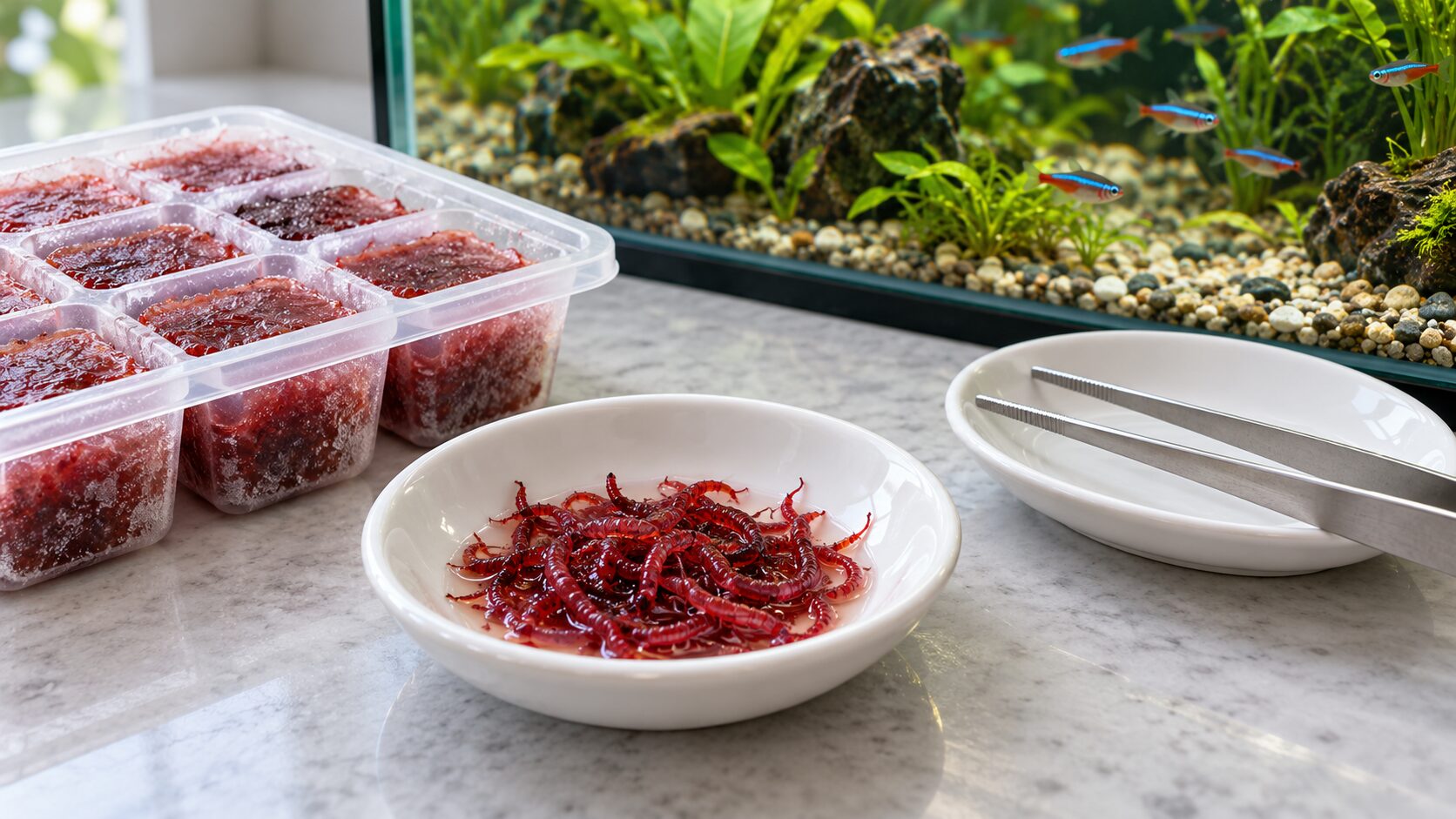
Bloodworm fish food is sold in several forms, and the form matters as much as the name. Before feeding, check whether the package is live, frozen, or freeze-dried, which fish it is intended for, and whether it is a supplement to the main diet. Do not apply one product’s thawing, portion, or storage instructions to every bloodworm food.
The useful first decision is not which package has the highest protein percentage. It is which format fits your fish, your storage setup, and a feeding routine you can manage without leaving excess food in the tank.
Frozen versus freeze-dried bloodworms: the practical difference
| Format | Before purchase | Before feeding |
|---|---|---|
| Frozen | Confirm reliable frozen delivery or local collection, suitable freezer storage, and a usable pack size. | Read the exact product directions. Some manufacturers specify feeding a frozen cube without prior thawing. |
| Freeze-dried | Check the intended fish and whether the label describes a treat or supplement. | Use the package’s preparation and portion directions. It is not handled like a frozen cube. |
| Live | Confirm a known supplier and handling guidance before introducing a new live source. | Follow source-specific care and feeding instructions; do not assume live means risk-free. |
Our live aquarium food guide covers the broader sourcing decision. This article focuses on choosing and handling bloodworm products rather than replacing that overview.
Can bloodworms be the main food?
Do not assume a bloodworm product is a complete daily diet. For example, Tetra describes its freeze-dried BloodWorms as a supplement to primary diets. That is a product-specific statement and a reason to keep a suitable staple food in the routine, not to replace it because the fish eat the treat eagerly.
Check the intended species and life stage before changing the diet. The Merck Veterinary Manual’s nutrition overview notes that aquarium-fish nutrition information is not equally detailed for every species. Feeding habits and access differ. A product marketed for omnivorous or carnivorous fish should not automatically become the routine food for every resident of a mixed aquarium.
Acceptance is useful information, but it is not proof of nutritional completeness. If a fish persistently refuses its normal diet or has a health concern, investigate the underlying issue rather than continually offering more bloodworms.
Should frozen bloodworms always be thawed first?
No universal instruction applies to every formula. Ocean Nutrition’s US Bloodworms page, inspected in October 2026, specifies that its cubes are designed to retain their form during feeding and should be used without prior thawing. Its cube ingredients include a gum ingredient, while the flat-pack formulation listed on the page differs. Those details explain why the exact package matters.
Follow the instructions on the product you actually buy. Do not convert the Ocean Nutrition cube directions into a recommendation for another brand or an unidentified frozen block. If you need a smaller portion, choose a pack you can portion according to its instructions or ask the manufacturer how to do so. A whole cube is not automatically the correct portion for a small aquarium.
Prepare only what the aquarium needs for that feeding. Keep the remaining food under the specified storage conditions, and do not improvise a universal refreezing rule. Where the package and a web page disagree, use the current package and ask the manufacturer for clarification.
Why the protein number can mislead
Frozen foods contain much more water than dry foods, so their printed nutrient percentages are not directly comparable with those of a dry pellet or freeze-dried food. The Ocean Nutrition example lists a high moisture maximum alongside its other guarantees. A lower printed protein percentage is not enough to decide that a frozen food is inferior.
Likewise, a higher dry-food protein figure does not prove the food supplies everything your fish require. Read minimum and maximum qualifiers, intended feeding use, and the ingredients together. Our guaranteed-analysis guide explains those limits without turning one number into a product score.
A careful first feeding
- Identify the exact format and confirm it is appropriate for the fish and their mouth size.
- Read the package directions before preparing the food.
- Offer a modest portion rather than adding a full cube or large pinch by default.
- Watch which fish reach the food and whether any pieces remain uneaten.
- Remove obvious leftovers as directed and adjust the next portion to the aquarium’s response.
Consider all food offered that day. Treats should not simply be added on top of an already generous feeding routine. See how much to feed aquarium fish for the broader portion check. If water conditions worsen, review feeding, stocking, and filtration rather than blaming or praising one food name.
Handling, storage, and allergy warnings
Ocean Nutrition’s product page includes an allergy warning for people handling the food. Read and respect the warning on your own package; do not assume processed or frozen food eliminates every handling concern. Avoid unnecessary direct contact, keep preparation tools separate from human food equipment, and follow the manufacturer’s handling guidance.
Frozen and freeze-dried products need different storage routines. Keep frozen food as instructed and keep dry food sealed according to its label. Neither format has one universal after-opening lifetime. Our fish food storage and spoilage guide covers printed dates and handling rather than promising that a fixed number of weeks fits every product.
Bloodworm feeding questions
Can I give every fish one whole cube?
No. A cube is a packaging unit, not a universal feeding portion. Consider the fish present, the product instructions, all other food offered, and whether leftovers remain.
Are freeze-dried bloodworms the same as live food?
No. They are a processed dry product, with different handling and storage needs. Tetra’s example is explicitly a dietary supplement. Read its label rather than using live-food instructions.
Will processing make bloodworms completely risk-free?
No such guarantee is made here. Tetra says its product is processed and tested to minimize undesirable organisms; that is not a promise that every bloodworm product or source has zero risk.
Should I buy a large pack to save money?
Only if you can store and portion that exact product appropriately. A manageable pack with clear instructions can be more useful than a bulk purchase that is difficult to use. No current price or availability comparison is claimed in this guide.
Sources and scope
- Ocean Nutrition: frozen Bloodworms ingredients, directions, and handling warning
- Tetra: freeze-dried BloodWorms and supplemental feeding use
- Merck Veterinary Manual: nutrition in fish
Manufacturer examples explain differences between formats. They are not hands-on product tests, a universal feeding prescription, or a ranked shopping list.